One of the most common questions our engineering team receives from facility managers and system designers is: “Can I leave my 2-way solenoid valve powered on all day?”
The short answer is yes—but only if you have specified the correct valve configuration.
In industrial fluid control, the most frequent cause of catastrophic valve failure is not a ruptured seal or a cracked brass body; it is a burned-out electromagnetic coil. When a 2-way valve is energized for too long without the proper thermal rating, the internal copper windings overheat, melt their insulation, and permanently short-circuit.
If your application requires a valve to remain in its actuated state for extended periods, you must understand the concept of Duty Cycle and design your system accordingly. Here is the technical guide to keeping your coils cool and your systems running.
1. Decoding the Duty Cycle (ED%) Rating
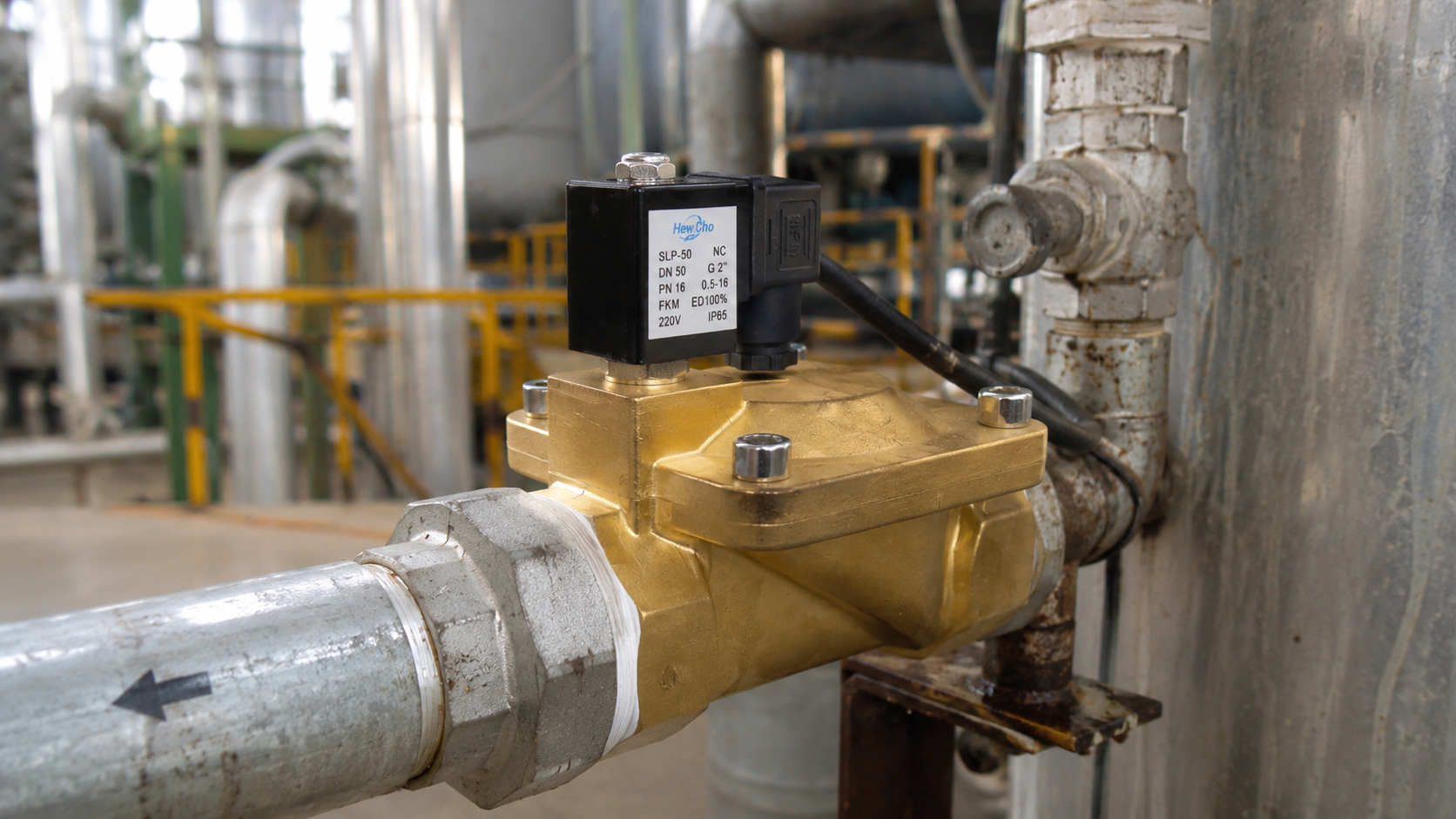
When you look at the technical specifications of a high-quality 2-way solenoid valve, you will often see a metric labeled ED% (derived from the German word Einschaltdauer). This is the valve’s Duty Cycle rating.
It dictates the maximum allowable percentage of time the coil can be energized within a specific time period without overheating.
- Intermittent Duty (e.g., 50% ED): This means the valve can only be energized for half of the operating cycle. If it is powered on for 10 minutes, it must be powered off for 10 minutes to allow the heat to dissipate into the ambient air. Using an intermittent duty coil for a continuous process guarantees a rapid burnout.
- Continuous Duty (100% ED): This is the industrial standard for premium 2-way valves. A 100% ED rating means the coil is engineered to be energized continuously, 24 hours a day, 7 days a week, without the risk of thermal degradation.
Procurement Tip: Always verify that the 2-way valves you are sourcing feature a 100% ED rating if they are going into automated manufacturing or continuous-flow water treatment systems.
2. The Importance of Coil Insulation Class
Even a 100% ED continuous duty coil generates a significant amount of heat. To survive this constant thermal stress, the insulation wrapping the internal copper wire must be exceptionally durable.
When purchasing continuous duty 2-way valves, pay close attention to the Insulation Class:
- Class B (130°C / 266°F): Suitable for light-duty, intermittent applications.
- Class F (155°C / 311°F): The gold standard for most industrial 100% ED continuous duty valves.
- Class H (180°C / 356°F): Mandatory for continuous duty applications operating in high-ambient-temperature environments (like boiler rooms) or when routing high-temperature fluids like steam.
3. The Smart Engineering Fix: Re-evaluating Your Failsafe
If you need a 2-way valve to be open 90% of the time, buying a standard Normally Closed (N/C) valve and keeping it energized 24/7 is highly inefficient. Even with a 100% ED coil, you are needlessly consuming electricity and generating excess heat.
The smartest engineering solution is to reverse your failsafe.
By installing a Normally Open (N/O) 2-way valve, the pipeline remains open naturally without drawing a single watt of electricity. The coil only needs to be energized during the rare 10% of the time you actually need to stop the flow. This completely eliminates the risk of coil burnout and drastically reduces your facility’s energy footprint.
4. The Ultimate Alternative: DC Latching Coils
What if your system requires the valve to stay open for three weeks, and then stay closed for three weeks, but you are operating on a remote, battery-powered solar setup?
In this scenario, continuous duty AC or DC coils will drain your battery bank instantly. The solution is the DC Latching 2-Way Valve. These specialized valves only require a 50-millisecond pulse of electricity to open, and a permanent magnet locks the plunger in place. It requires absolutely zero power to stay open continuously. Another brief pulse reverses the polarity and closes it. For remote agricultural irrigation and off-grid tank management, latching technology is the ultimate protection against coil burnout.
The Bottom Line
You absolutely can leave a 2-way solenoid valve actuated continuously, provided you engineer the system for it. By verifying a 100% ED rating, checking your insulation class, or intelligently utilizing Normally Open configurations, you can eliminate coil failures and ensure years of uninterrupted fluid control.
What topic should we tackle next to continue building your site’s authority? We could explore “How to Properly Size a 2-Way Valve using the Flow Coefficient (Cv)” (a very math/engineering-focused guide) or “Troubleshooting Water Hammer in 2-Way Valve Systems.”