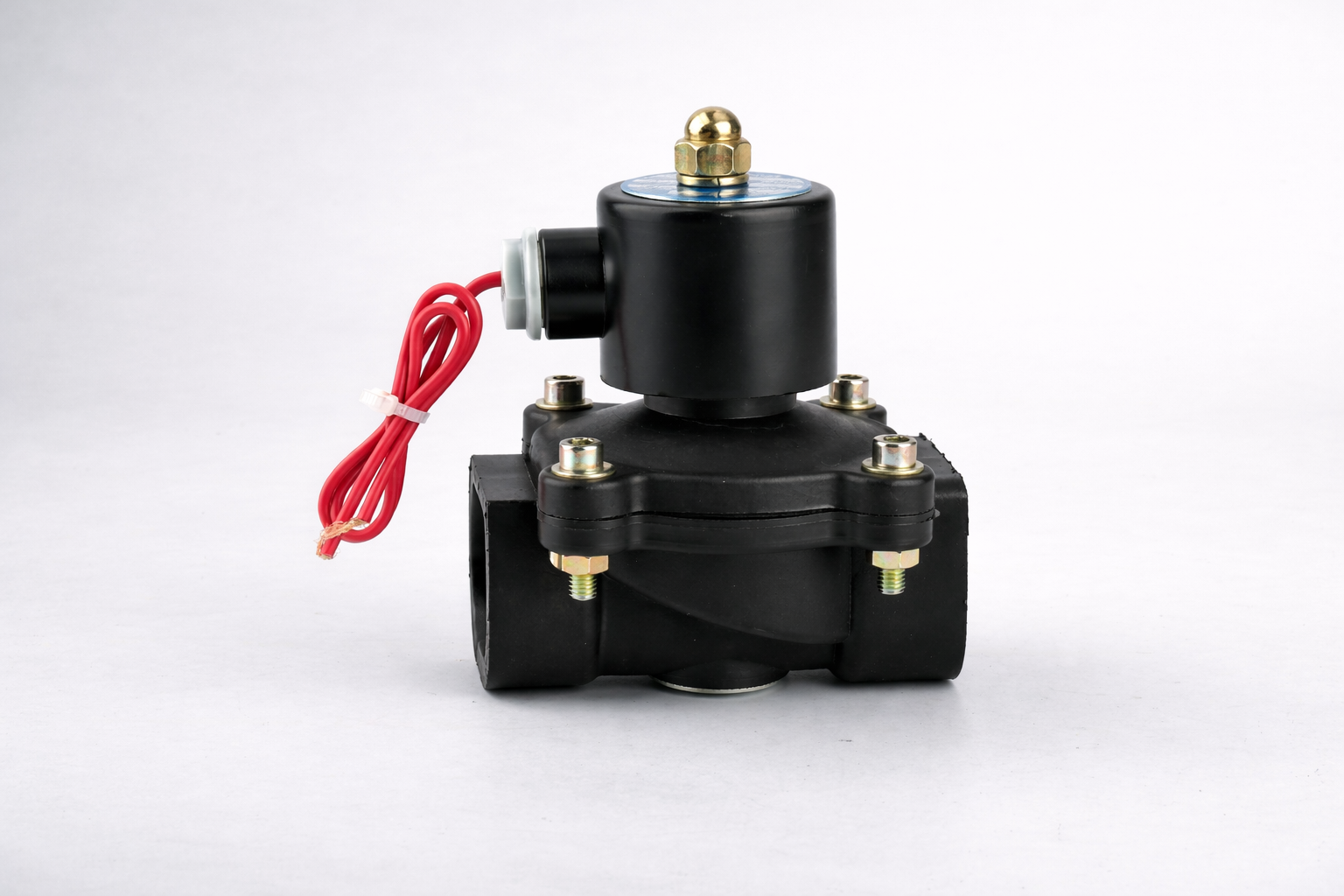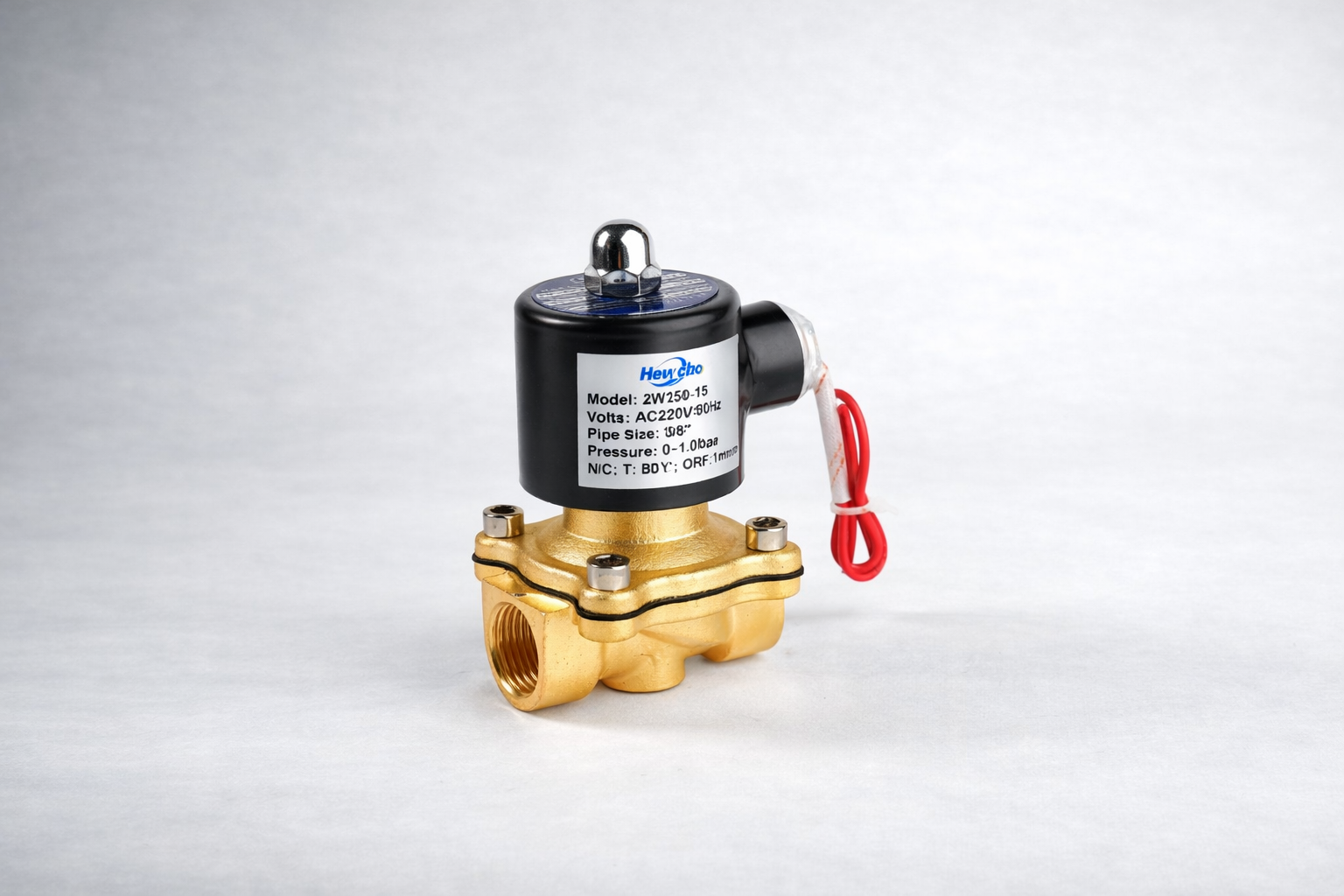
If your lines bang, rattle, or shake when a valve snaps shut, you’re dealing with water hammer. It’s more than a noise problem—it cracks fittings, trips sensors, and shortens valve life. Here’s a concise, field-tested playbook to prevent it when using solenoid valves.
Why water hammer happens (the 10-second version)
A fast valve closure suddenly changes fluid velocity. That change turns into a pressure wave that runs back and forth in the pipe.
A quick estimate (liquids) is the Joukowsky relation: ΔP≈ρ a Δv\Delta P \approx \rho \, a \, \Delta vΔP≈ρaΔv
- ρ\rhoρ: fluid density (kg/m³)
- aaa: wave speed in the pipe (m/s) — typically 300–1200 m/s depending on pipe material and contents
- Δv\Delta vΔv: change in fluid velocity (m/s)
Even a modest Δv=0.5\Delta v = 0.5Δv=0.5 m/s can mean tens of bar in rigid metal lines.
How solenoid valves make it worse (or better)
- Oversized orifice / high Cv: Bigger, faster flows → larger Δv\Delta vΔv.
- Instant close: Standard poppets shut in milliseconds; great for safety, rough on piping.
- Trapped volumes: Dead-ends and long rigid runs reflect waves like a drum.
How they help: Right-sized orifices, soft-close designs, and pilot trims that stage the pressure drop can cut hammer dramatically.
Fast diagnostics you can do today
- Listen + feel: Thump near the valve? Closure is too abrupt or Cv too high. Farther away? Look for long, rigid straight runs with no cushion.
- Watch gauges: A needle that flicks or “rings” after each cycle = transient spikes.
- Check cycle logs: Nuisance trips on pressure or flow switches right after closure = classic water hammer signature.
Engineering fixes (ranked by impact)
- Size by Cv, not pipe size
If you need 5 GPM at 8 psi ΔP (water), required Cv≈5/8≈1.77C_v \approx 5 / \sqrt{8} \approx 1.77Cv≈5/8≈1.77.
Choosing a Cv 5 “for safety” triples velocity—and the spike. - Choose soft-close or damped solenoids
Look for language like “anti-water-hammer,” “cushioned closing,” “slow-closing pilot.”
Target closing time ≥ 200–500 ms for utility water without losing process control. - Add compressibility
- Air chambers / accumulators near the valve outlet absorb the spike.
- A short flexible hose segment can help in otherwise rigid runs (stainless/PTFE braided, rated for the pressure).
- Control velocity
Keep liquid velocities ≤ 1–2 m/s in closing sections. If you’re above that, downsize Cv or add a short throttling element upstream (orifice plate) so the solenoid isn’t doing all the work. - Stage the closure
Two-valve trick: a small pre-close solenoid (low Cv) closes first, large one follows after 150–300 ms. You step down velocity before the final shut. - Mind the layout
- Avoid long, dead-end branches.
- Support pipes near valves to keep movement from amplifying the shock.
- Place the valve closer to the source than to pressure-sensitive instrumentation when practical.
- For air lines (bangs on exhaust)
Fit silencers and ensure actuator volumes aren’t slamming shut. In pneumatics, a wrongly set quick-exhaust can produce its own “hammer.”
Quick selector: which valve for which line
| Application | Recommended Trim | Notes |
|---|---|---|
| Utility water, frequent on/off | Soft-close solenoid, Cv sized to need | Aim for 200–500 ms close |
| Long stainless run to sensitive equipment | Pilot-damped solenoid + accumulator downstream | Keep velocity ≤ 1.5 m/s |
| CIP/clean steam condensate return | Direct-acting (0 bar capable) + drip leg | Wet steam/condensate spikes are brutal—trap properly |
| Glycol mixes (higher viscosity) | Soft-close + Y-strainer 80–100 μm | Viscosity reduces damping—don’t oversize Cv |
| Compressed air purge | Standard solenoid + mufflers | If banging persists, add a small needle exhaust restrictor |
Commissioning checklist (10 minutes, big wins)
- Cycle test: Record open/close times; confirm soft-close is within spec.
- Gauge check: Watch upstream/downstream needles during closure—no “bounce” allowed.
- Noise pass: Two operators, one at the valve and one 10–20 m away; both should hear only a dull, quick stop—not a hammer.
- Support audit: Verify clamps near tees, elbows, and the valve body.
Maintenance that keeps things quiet
- Clean the pilot orifices and pole faces each quarter; debris turns soft-close into slam-shut.
- Drain air chambers per manufacturer guidance so they keep their cushion.
- Replace tired check valves nearby—leaky checks cause reverse surges on closure.
Mini case: bottling line “midnight thumps”
A 25 mm stainless line with a high-Cv pilot-operated solenoid was slamming a filling manifold. We swapped to a soft-close direct-acting valve sized to Cv 2.2 (down from ~5), added a 0.5 L accumulator 0.5 m downstream, and set a 250 ms delayed interlock on a neighboring shutoff. Result: spikes fell from ~18 bar to under 6 bar; the night crew stopped reporting “mystery bangs.”
Bottom line
Water hammer is a velocity problem multiplied by stiffness and speed. Right-size Cv, slow the closure, add a cushion, and support the pipe. Do those four, and your solenoid valves will run quietly for years—no midnight thumps, no cracked fittings, no ghost alarms.
Have a noisy line right now? Tell me pipe size/material, fluid, normal flow, run length, and the valve’s close time. I’ll map out a quick, low-cost mitigation plan you can try on your next maintenance window.