When designing fluid control pipelines, most engineers are focused on managing positive pressure—holding back the forceful push of water, compressed air, or hydraulic fluid. However, an entirely different set of physics takes over when you need to control a vacuum.
From high-speed robotic pick-and-place machines to commercial food packaging and laboratory degassing, vacuum systems rely on negative pressure to do the heavy lifting. In these environments, the 2-way solenoid valve acts as the critical gatekeeper, breaking or maintaining the vacuum to release or grip a product.
But here is the catch: applying a standard, off-the-shelf 2-way water or air valve to a vacuum line is almost guaranteed to result in system failure. Here is the technical guide to understanding why vacuum acts differently, and how to specify the exact 2-way solenoid valve for the job.
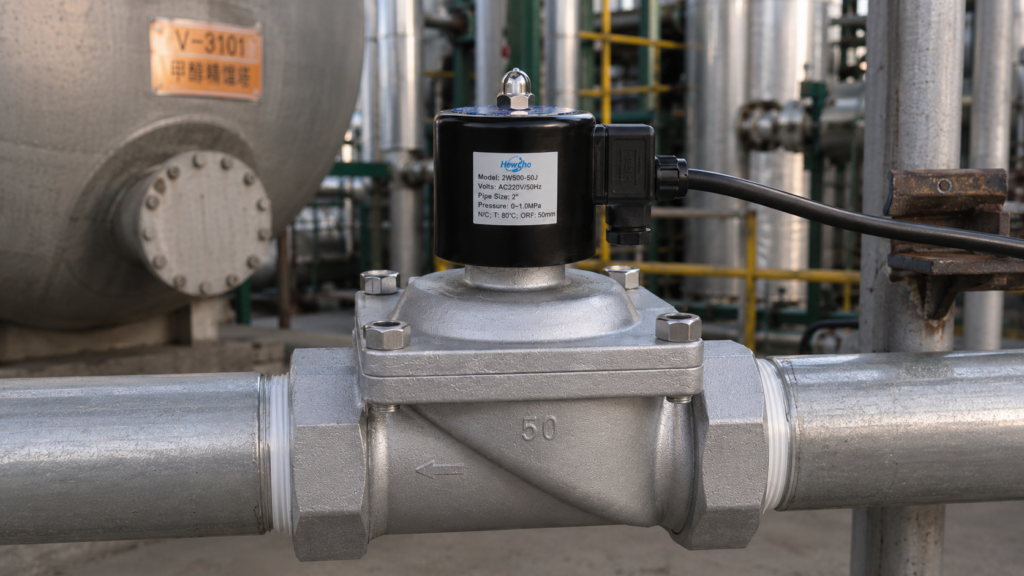
1. The Death of Pilot-Operated Valves
The most critical mistake made in vacuum system design is selecting a pilot-operated 2-way valve.
Pilot-operated valves rely on the positive pressure of the fluid entering the valve to push against a internal diaphragm, forcing the valve open. In a vacuum system, this positive inlet pressure does not exist; instead, the system is actively pulling a negative pressure. A pilot-operated valve installed in a vacuum line will simply refuse to open, or it will uncontrollably flutter as the vacuum struggles against the internal spring.
The Engineering Solution:
For vacuum applications, you must specify Direct-Acting or Semi-Direct Acting 2-way solenoid valves.
In a direct-acting valve, the electromagnetic coil is mechanically linked to the internal plunger. When energized, the coil uses raw magnetic force to physically lift the seal off the orifice, requiring absolutely zero pressure assistance from the system. This allows the valve to operate flawlessly from $0$ Bar down to a deep vacuum state.
2. Managing “Reverse Flow” and Installation Direction
Standard 2-way solenoid valves are highly directional. They are designed so that the positive inlet pressure pushes the plunger down onto the valve seat, assisting the internal spring in creating a bubble-tight seal.
A vacuum system flips this dynamic upside down. If a vacuum pump is pulling from the outlet side of the valve, it is essentially trying to suck the plunger open. If the vacuum force exceeds the strength of the valve’s internal return spring, the valve will get pulled slightly open, causing a massive, continuous leak.
How to Install for Vacuum:
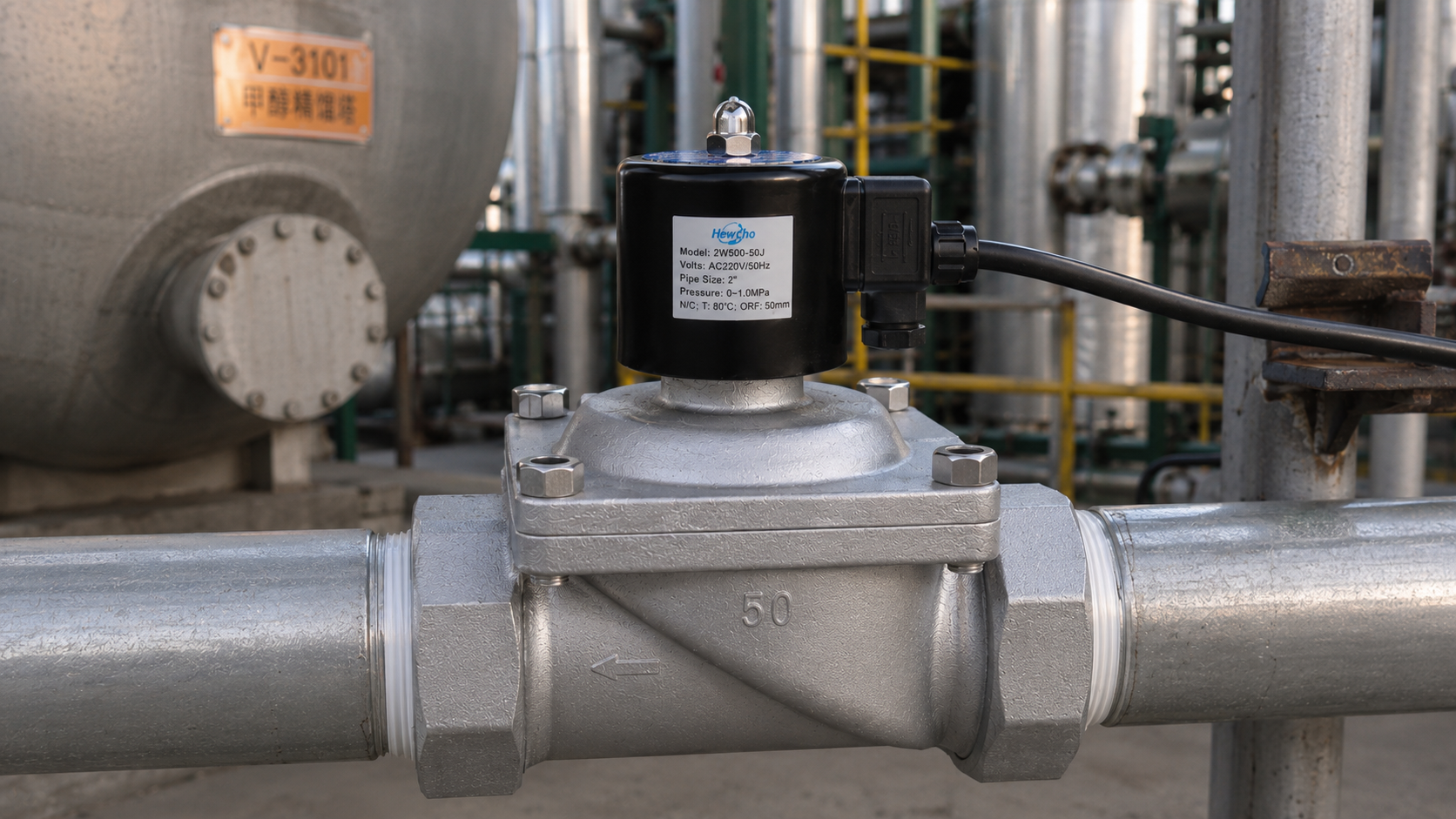
When installing a direct-acting 2-way valve in a vacuum line, you must pay strict attention to the flow direction arrow on the brass or stainless steel body. The vacuum pump should always be connected to the outlet port (the head of the arrow), while the suction cup or process chamber is connected to the inlet port (the tail of the arrow). This ensures the vacuum force pulls the internal seal tighter against the orifice, rather than pulling it open.
3. The Importance of “Bubble-Tight” Sealing
A tiny, microscopic leak in a standard water line might result in a single drop of water every hour—an annoyance, but rarely a critical failure. In a vacuum system, that same microscopic leak will allow atmospheric air to continuously rush into the system, destroying the vacuum and causing robotic suction cups to drop expensive payloads.
Vacuum systems require absolute, bubble-tight sealing.
- Avoid PTFE (Teflon) Seals: While incredible for high-temperature steam, PTFE is a hard plastic. It does not conform perfectly to the microscopic imperfections of the valve seat, making it unsuitable for holding a deep vacuum.
- Specify Soft Elastomers: For industrial vacuums, high-grade NBR (Buna-N) or FKM (Viton) are the mandatory choices. These soft elastomers compress tightly against the brass or stainless steel orifice, eliminating air gaps and maintaining strict negative pressure.
4. Maximizing Flow for Faster Cycle Times
In automated packaging or robotics, cycle speed is everything. The faster the vacuum can be applied and released, the more products your facility can move.
When a direct-acting 2-way valve opens to break a vacuum, atmospheric air must rush into the valve to equalize the pressure. If the valve’s internal orifice is too small, it creates a bottleneck, and the suction cup will take too long to release the product. To optimize your cycle times, always select a direct-acting 2-way valve with the largest internal orifice (and highest $C_v$ rating) that your pipeline and power supply can support.
The Bottom Line
Vacuum systems are unforgiving. They expose every microscopic leak and mechanical flaw in a fluid control system. By abandoning pilot-operated designs and exclusively sourcing direct-acting 2-way solenoid valves with premium soft elastomers, you can ensure your robotic automation and vacuum packaging lines operate with absolute precision and zero dropped loads.