Yesterday, we navigated the absolute thermodynamic boundaries of cryogenic fluid management, exploring how extended bonnets, vapor barriers, and Kel-F (PCTFE) seating protect lines from two-phase flash boiling. Today, we shift our focus from sub-zero space launch applications to highly volatile chemical oxidizers, specifically analyzing the extreme material compatibility and safety demands of routing High-Concentration Hydrogen Peroxide (H2O2).
Whether utilized as a green monopropellant in aerospace thrusters (at concentrations exceeding 85%, known as High-Test Peroxide or HTP) or as an industrial bleaching and sanitizing agent in pharmaceutical and pulp facilities (at 30% to 50% concentrations), hydrogen peroxide introduces a severe operational paradox. It is not inherently corrosive like strong acids, but it is thermodynamically unstable.
If \text{H}_2\text{O}_2 encounters the wrong trace metals or a stagnant pocket inside a standard 2-way solenoid valve, it initiates an uncontrollable exothermic catalytic decomposition. This reaction turns the liquid into superheated steam and oxygen, triggering a rapid pressure spike that can violently rupture the valve. Here is the technical material science framework required to safely specify 2-way valves for hydrogen peroxide service.
1. The Physics of Catalytic Decomposition and Overpressure
To engineer a safe 2-way valve for \text{H}_2\text{O}_2, one must treat the fluid as a sleeping chemical giant. The molecule consists of a single, weak oxygen-oxygen single bond:
$$2\text{H}_2\text{O}_2 \xrightarrow{\text{Catalyst}} 2\text{H}_2\text{O} + \text{O}_2 + \text{Heat}$$
If the fluid passes through a valve body containing incompatible materials, the surface of that material acts as a catalyst. The decomposition reaction accelerates exponentially, generating vast quantities of oxygen gas and releasing 98\text{ kJ/mol} of thermal energy.
The Trapped Fluid Bomb
Imagine a Normally Closed (N/C) 2-way solenoid valve that has cycled shut, trapping a tiny volume of 70% \text{H}_2\text{O}_2 inside its internal armature tube cavity. If the internal plunger or guide tube shell is made of a standard ferritic stainless steel, it will act as a catalyst.
The trapped liquid will rapidly boil and expand into gas. Because the valve is closed and the fluid is trapped in a rigid dead-volume chamber, the pressure will skyrocket past the structural yield limit of the valve bonnet within seconds, resulting in an explosive mechanical failure.
2. Material Passivation and Categorization Metrics
To eliminate catalytic decomposition risks, all wetted components within the 2-way valve must be strictly audit-checked against official hydrogen peroxide compatibility scales (such as the Rocketdyne Material Compatibility Ratings). Materials are classified into four strict categories:
Class 1: Fully Compatible (Unlimited Long-Term Storage)
These materials exhibit zero catalytic activity and do not degrade the peroxide over years of exposure.
- Metallurgy: Pure Aluminum (99.5% or higher) and specific ultra-pure aluminum alloys (such as 1060 or 5254). Aluminum naturally forms an unreactive, dense aluminum oxide passivation layer that completely blocks catalytic interaction.
- Polymers: Virgin PTFE (Teflon) and PFA. These fully fluorinated plastics possess no reactive sites, making them the absolute standard for seat seals and isolating diaphragms.
Class 2: Satisfactory for Short-Term Process Systems
These materials cause minor decomposition over long periods but are fully safe for active, flowing process lines.
- Metallurgy: 316L Stainless Steel. While 316L contains iron (a strong catalyst), its high chromium and nickel content allows it to be rendered safe through an intensive chemical process called Nitric Acid Passivation.
Before installation, the 2-way valve body is bathed in a hot nitric acid solution to intentionally strip away all free iron atoms from the surface matrix, leaving behind a pristine, unreactive layer of chromium oxide.
Class 4: Prohibited Catalytic Traces
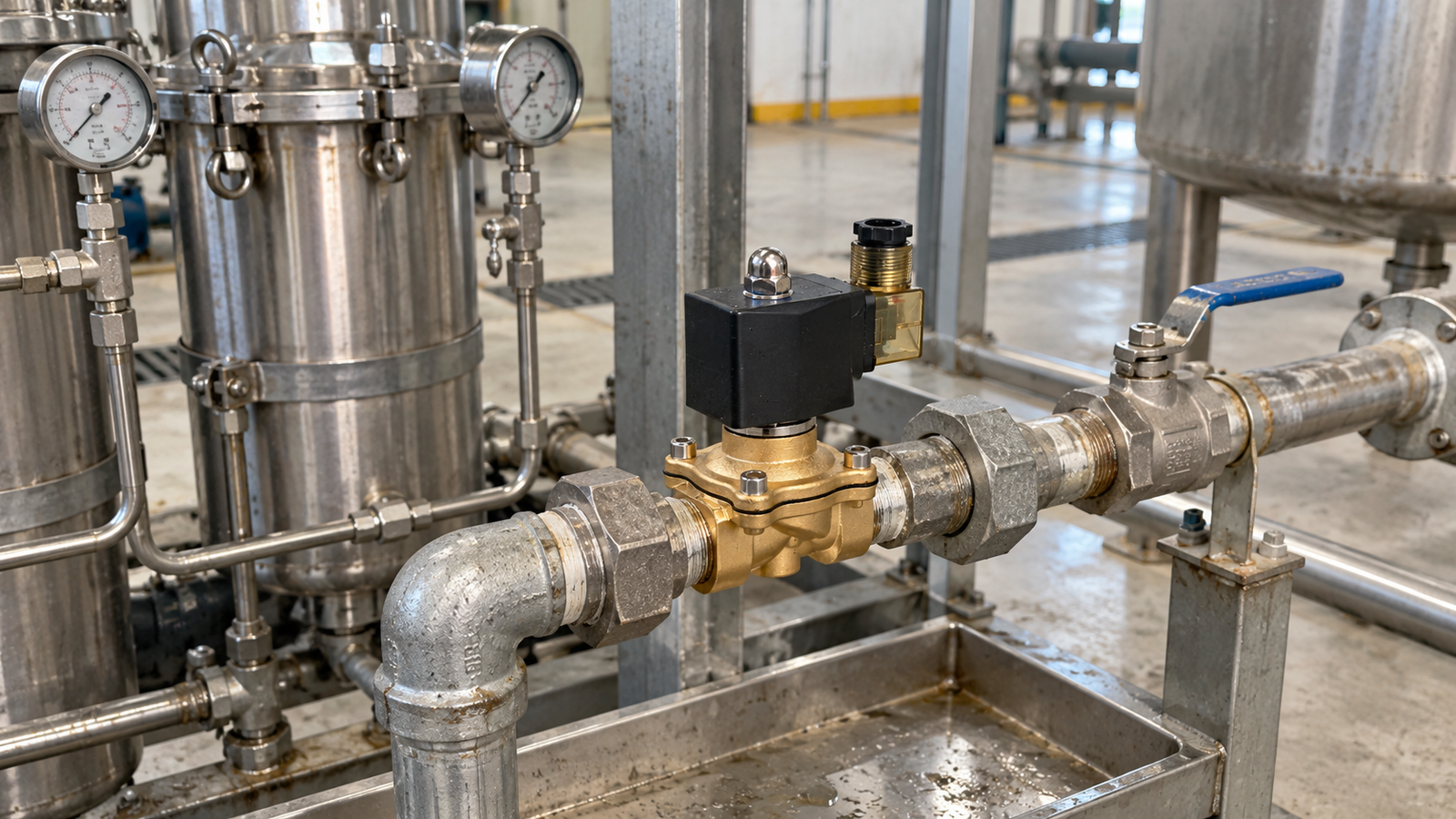
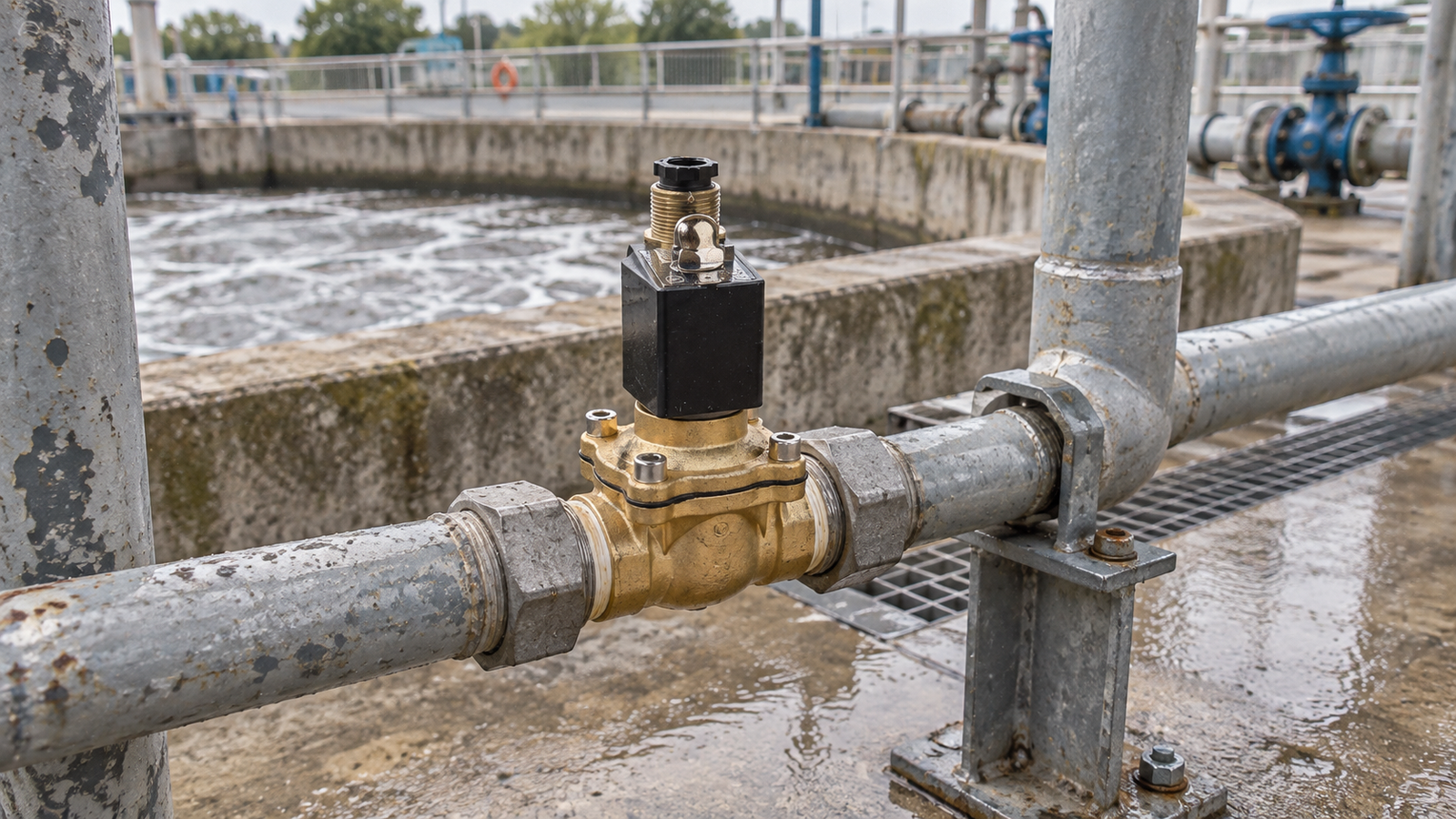
Materials that cause instantaneous, violent decomposition on contact. Copper, Brass, Bronze, Lead, Silver, and Mild Carbon Steel are strictly prohibited. A single brass fitting or a standard brass 2-way valve body used in an HTP line will act as a chemical detonator.
3. Structural Safeguards: Internal Media Isolation and Upstream Venting
Beyond strict metallurgical auditing, the physical architecture of the 2-way valve must be adapted to prevent pressure entrapment:
Diaphragm-Isolated Dry Armature Construction
To keep the hydrogen peroxide away from the spring and magnetic plunger—which are typically machined from 430FR ferritic stainless steel for magnetic efficiency—engineers mandate a media-isolated design.
A robust PTFE convoluted diaphragm completely seals off the lower fluid body from the upper armature. The plunger and return spring remain completely dry, ensuring that highly catalytic ferritic metals never touch the chemical stream.
Calibrated Internal Relief Channels (Internal Venting)
If a 2-way valve must handle high-concentration peroxide without total media isolation, the internal geometry must incorporate a safety relief path.
Advanced 2-way valves machine a tiny, calibrated bleed slot or a check-valve bypass directly into the upstream side of the valve seat or plunger disk. This ensures that if the valve is closed and internal decomposition begins, the expanding gas can vent backwards into the upstream supply pipeline rather than becoming trapped inside the valve body, neutralizing the threat of an overpressure explosion.
Sourcing Specs for High-Concentration Oxidizer Loops
When engineering fluid control networks for hydrogen peroxide bleaching lines or green rocket propulsion skids, enforce these mandatory hardware specifications:
| Engineering Parameter | Sourcing Requirement | Process Justification |
|---|---|---|
| Wetted Body Metallurgy | Passivated 316L Stainless Steel or 6061-T6 Aluminum | Minimizes surface catalytic activity; prevents exothermic decomposition loops. |
| Internal Configuration | Zero-Dead-Volume / Media-Isolated Path | Eliminates stagnant fluid traps where localized decomposition can build pressure. |
| Static and Dynamic Seals | Virgin PTFE or Kalrez (FFKM) | Avoids elastomer degradation, blistering, or chemical leaching into the peroxide stream. |
| Cleaning Standard | ASTM G93 Level Level C (Oxygen/Oxidizer Clean) | Guarantees the valve arrives 100% free of hydrocarbon greases, oils, or dust particles, all of which trigger immediate peroxide ignition. |
Conclusion
Oxidizer automation is governed by molecular surface reactions. In high-concentration hydrogen peroxide lines, treating a fluid loop like a standard chemical or water system can create an immediate containment failure. By strictly enforcing passivated 316L stainless steel or pure aluminum configurations, deploying dry armature media-isolation barriers, and ensuring all assemblies undergo rigorous oxidizer-level decontamination, you keep your chemical process stable—ensuring safe, highly efficient, and explosion-free flow isolation.