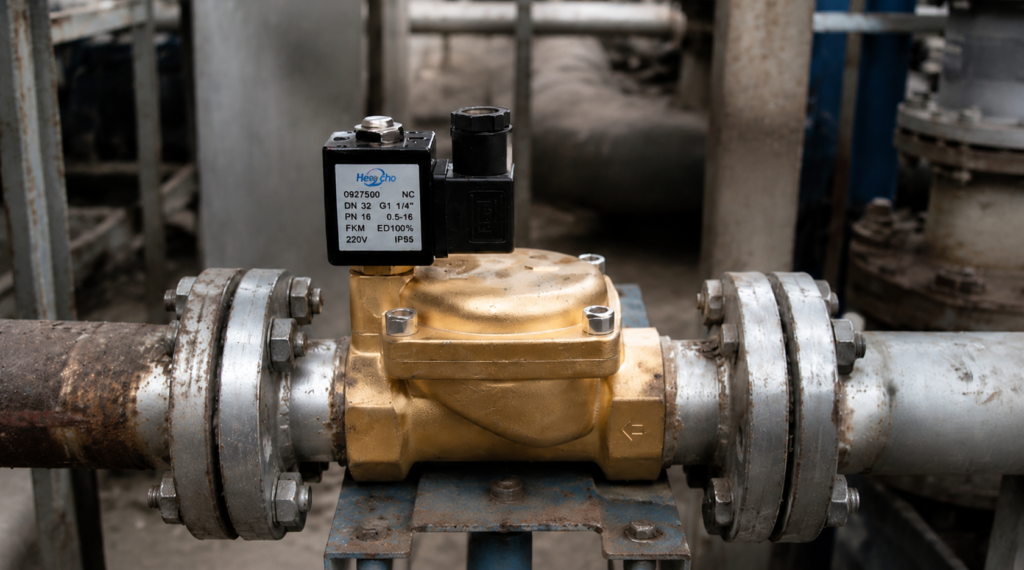
Yesterday, we discussed the optimization of magnetic flux paths, eddy current suppression through laminated silicon-steel cores, and kinetic energy dissipation using fluid-cushioning profiles in high-frequency 2-way solenoid valves. Today, we address the critical interplay between fluid dynamics and mechanical stress under extreme operating envelopes, focusing on simultaneous mitigation of water hammer (transient shockwaves) and Vena Contracta cavitation erosion in high-flow, high-pressure 2-way valve architectures.
In heavy industrial process loops—such as high-pressure washdown systems, boiler feedwater lines, and chemical injection skids—2-Way solenoid valves are routinely subjected to aggressive pressure differentials (\Delta P) and rapid actuation speeds. When these variables intersect improperly, the system experiences compounding destructive forces: the violent mechanical shock of water hammer combined with the localized micro-jet bombardment of cavitation. Here is the advanced engineering framework for neutralizing both phenomena simultaneously.
1. The Coupled Destructive Matrix: Water Hammer Meets Cavitation
Operating a high-flow 2-way valve under severe pressure drops creates a dual-threat operational environment where fluid dynamics and mechanical transient forces interact:
- The Rapid Closure Shock (Joukowsky Effect): When a valve abruptly shuts off high-velocity flow, the kinetic energy of the moving fluid mass converts into an elastic pressure wave. The magnitude of this surge (\Delta P = \rho \cdot c \cdot \Delta v) stresses the pipeline and tests the structural yield strength of the valve body.
- The High-Velocity Opening Shear (Cavitation): Conversely, when the valve cracks open against high upstream pressure, fluid flashes through the restricted orifice. The extreme velocity spike at the Vena Contracta drops local static pressure below the vapor pressure of the liquid, generating vapor bubbles that implode violently downstream.
If a valve is engineered only to survive water hammer (e.g., by utilizing heavy mass and thick walls) but ignores cavitation mechanics, the internal valve seat and downstream body wall will rapidly pit, erode, and fail prematurely.
2. Advanced Multi-Stage Flow Control and Pressure Staging
To eliminate both cavitation and water hammer at the source, advanced valve architectures abandon single-stage orifice designs in favor of multi-stage pressure staging and graduated flow profiling:
Multi-Step Orifice Trim Design
Instead of forcing the entire pressure drop across a single sharp-edged seat, high-reliability severe-duty 2-way valves utilize a multi-step plug or tiered seat trim.
- The Mechanical Benefit: The pressure drop is broken down into incremental, manageable steps. By keeping each individual \Delta P step below the critical cavitation index (\sigma), vapor bubbles never form, completely eliminating Vena Contracta cavitation erosion.
Integrated Slow-Closing Dashpot Dampers
To combat water hammer without sacrificing automated electronic control speed, advanced pilot-operated 2-way valves incorporate an internal hydraulic dashpot with an adjustable needle valve.
- The Mechanical Benefit: When the solenoid de-energizes, the dashpot forces the main diaphragm or piston to descend through a controlled, decelerated stroke profile (\Delta t). This stretches the fluid deceleration time, flattening the Joukowsky pressure wave curve and preventing hydraulic shock across the piping network.
3. Advanced Metallurgy: Stellite Hardfacing and Cavitation-Resistant Alloys
Even with optimal hydraulic staging, severe industrial applications often require secondary metallurgical safeguards to ensure absolute longevity. Standard 316 stainless steel or brass bodies are structurally inadequate for continuous high-velocity flashing services.
- Cobalt-Chromium Hardfacing (Stellite #6): Critical seating surfaces and high-velocity impingement zones are overlaid with Stellite via plasma transferred arc (PTA) welding. Stellite possesses an exceptionally high work-hardening capacity, allowing the metal to absorb the micro-impact energy of imploding cavitation vapor bubbles without cracking or pitting.
- Duplex and Super-Duplex Stainless Steels: For corrosive and high-pressure liquid lines, valve bodies are cast from 2205 or 2507 Duplex Stainless Steel, offering double the yield strength of standard austenitic stainless steels and exceptional resistance to stress corrosion cracking (SCC) caused by turbulent shock fronts.
Technical Sourcing Specs for Multi-Variable Severe-Duty Systems
When compiling engineering specifications for 2-way solenoid valves operating in high-pressure, high-velocity fluid loops subject to both shock and cavitation, enforce these advanced manufacturing standards:
| Performance Metric | Sourcing Requirement | Engineering Justification |
|---|---|---|
| Orifice Pressure Staging | Multi-Step Tiered Trim Geometry | Prevents localized pressure drops below fluid vapor pressure, eliminating Vena Contracta cavitation. |
| Transient Shock Mitigation | Adjustable Hydraulic Dashpot / Slow-Closure Control | Broadens stroke closure time (\Delta t), flattening the Joukowsky wave curve to prevent water hammer. |
| Seat & Body Metallurgy | Stellite #6 Hardfaced Orifice / Super Duplex Body | Absorbs high-frequency micro-jet impact energy and provides elite structural yield strength. |
Conclusion
Mastering high-pressure fluid control requires an integrated approach that simultaneously accounts for transient momentum changes and boundary-layer micro-physics. By combining multi-stage pressure-staging trims to suppress cavitation with hydraulic dashpots and Stellite hardfacing to neutralize water hammer and mechanical fatigue, you transform a standard fluid switch into an industrial-grade severe-service actuator. This rigorous, multi-variable engineering guarantees long-term operational integrity, safety, and zero unscheduled downtime in your most demanding process loops.